OK, let's be honest. You're in the bathroom, doing your thing, and you've left your phone in the other room. Now how are you going to occupy your time? You, like me, probably look around for something, anything, to read. Ahh... There's a shampoo bottle within reach. So, you, like me, start reading the label. At this point we turn into scientists because the label's filled with long, chemical-ly sounding words, like: Sodium Laurel Sulfate (that's the one that does the foamy stuff and burns your eyes). Catching your eye at the bottom of the label is the all too familiar South African Bureau of Standards (SABS) stamp of approval, letting us know as consumers that the chemical-ly sounding chemicals are fine to use and won't harm us. This led me to a realisation: so many of us have read our shampoo and conditioner bottles and even the back of the toilet spray. But what about our medicine?
Much More Than Meaningless Graffiti
All medicines must be officially approved before being released for public use, which includes all the medicine-y sounding medicine names graffiti'ed on the side of the bottle or box. When I ask people if they've ever read them, 9 times out of 10, the answer is “no” (but I bet that Sodium Laurel Sulfate rings a bell!). It's a pity, because other than the confusing names, which I don't expect anyone to recognise, there's a key piece of information that actually keeps you safe: how to store your life-saving, head-ache-fighting, sore-throat soothing drugs properly.
When you read, “Store below 8°C” or “Store below 25°C”, you may think, “OK, so what, who cares? I don't have a thermometer anyway!” These directions represent so much more than just meaningless graffiti put there by some nameless graffiti artist — they ensure that your medicine carries on working effectively.
The Graffiti Artists
The South African pharmaceutical industry has two rather famous, cool-kid graffiti artists. The first is the South African Health Products Regulatory Authority (SAHPRA), our primary protectors, as they regulate everything from manufacturing to distribution. Once a drug is declared safe by SAHPRA, the South African Pharmacy Council (SAPC) steps in. They control and regulate all pharmacy premises, pharmacists and support personnel. Both SAHPRA and SAPC are mandated by the Department of Health (under auspices of the South African Government and its constitution) to watch over us ordinary South Africans and the health products we consume. It's a massive task and has, more or less, been done extremely well.
SA Pharma-Regulatory Landscape: How It All Links Together
As a Validation Consultant in the pharmaceutical industry, one of the biggest issues I contend with, but enjoy solving, is that many people are unaware of the latest guidelines, established rules, regulations, or structure of the regulatory environment in South Africa. When I mention a particular regulation, technical point, or principle from a SAHPRA or SAPC document, I'm generally met with some unsure head-nodding, blank stares, and my biggest challenge, a dismissive wave of the hand. What I've learnt is that the mass of guidelines, while helpful, can sometimes be daunting to read and intimidating to apply. It's great that they're available, but where do you even start looking? As a result, there's a fundamental knowledge gap that needs to be filled.
The best place to start is by having a clear understanding of SAHPRA and SAPC, what they do, and where these bodies fit into the governmental regulatory structure.
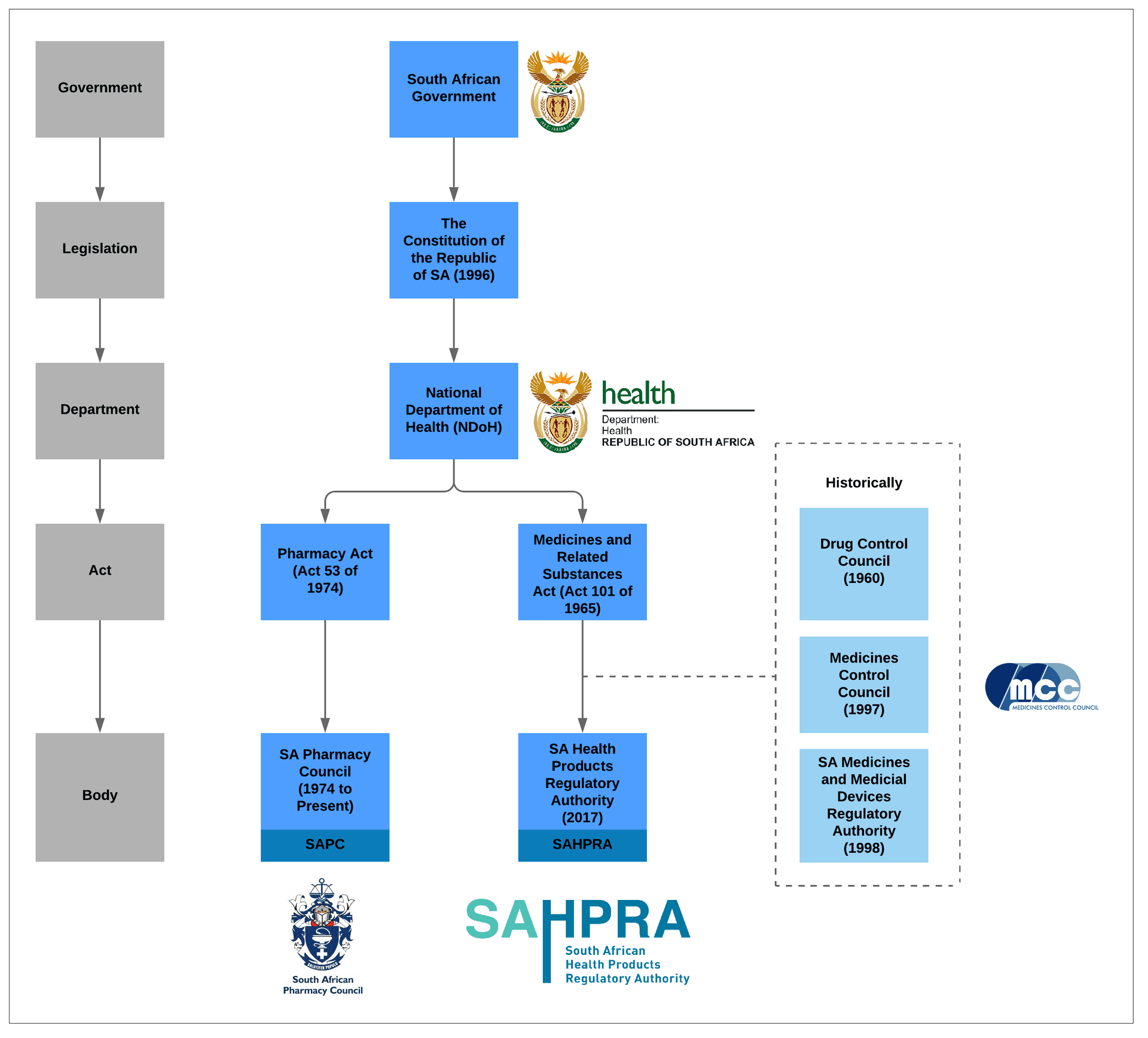
Figure 1: Flow diagram of the regulatory body framework for health and pharmaceutical products in South Africa. © GxP Mentor Pty Ltd. All rights reserved.
RIP MCC. SAHPRA Is the New Kid on the Block
Over the years, the regulatory body responsible for oversight of all things medicine-related has evolved several times. When it was initially formed in 1960, it was known as the Drug Control Council. In 1997, after an amendment to Act 101, it was reformed into the Medicines Control Council (MCC). Just 20 years later, in February 2017, the once famous MCC was officially retired and SAHPRA was formed.
A little known fact: in 1998 there was a brief moment when it was nearly reclassified as the South African Medicines and Medical Devices Regulatory Authority (SAMMDRA), but this wasn't promulgated.
SAHPRA's role is to regulate all health products in South Africa, which includes clinical trials, complementary medicines, medical devices, and in-vitro diagnostic equipment. They perform these duties under the mandate of the Medicines and Related Substances Act (Act No 101 of 1965 as amended) and the Hazardous Substances Act (Act No 15 of 1973). An important new addition to SAHPRA's repertoire is overseeing radiation control and hazardous substances — even granting licences for the growth, distribution and manufacture of cannabis-containing pharmaceutical products.
SAHPRA has recently undergone a massive shake-up. Part of this overhaul was separating the responsibilities of the CEO and the newly created position of Chief Regulatory Officer (CRO). The recently appointed CEO is Dr Boitumelo Semete-Makokotlela, whose focus is the strategic oversight of the regulator. The new CRO is Dr Portia Nkambule, whose focus is the technical oversight of regulatory guidelines and their application in SA.
3 Key People to Know at SAHPRA
- Professor Helen Reese — Chairperson of the Board
- Dr Boitumelo Semete-Makokotlela — Chief Executive Officer (CEO) — Responsible for strategy, operations, stakeholder engagement, innovation
- Dr Portia Nkambule — Chief Regulatory Officer (CRO) — Responsible for oversight of all technical aspects, regulations, legislation, and to ensure guidelines are aligned with global standards
5 Main Regulatory Arms of SAHPRA
- Human Medicine — Including Orthodox medicines, Complementary medicines, and Biologicals
- Medical Devices — Divided into Non-In-vitro Diagnostic (Non-IVDs) and IVDs
- Radiation Control — Newly added. Includes products such as radio-isotopes
- Unregistered Medicines — Products released for sale by Section 21 unit of SAHPRA, under Regulation 29 of the General Medicines Regulations
- Veterinary Medicines — Drugs for the treatment of animals
The Immortal Pharmacy Council
Where does the South African Pharmacy Council (SAPC) fit in to everything? Under South African law, all pharmacists, pharmacy students, pharmacy support personnel and pharmacy premises must be registered with the SAPC. In principle, the SAPC is an independent statutory council mandated by the Pharmacy Act (Act 53 of 1974) to provide patient-centric health and pharmaceutical services to the people of South Africa. Since the main driver of pharmacies is dispensing medicines, the SAPC falls under the Department of Health.
A little-known fact: the head of this council also advises the Minister of Health in all pharmacy-related matters.
To my knowledge there's been no change to this council since its inception in 1974, so it's been consistent for the last 46 years, with the exception of only minor updates and amendments to Act 53 and Good Pharmacy Practice (GPP). A recent and important update made by the SAPC to align the Rules Relating to GPP now includes elements of Good Wholesaling Principles (GWP). This update was made specifically in the section regarding “minimum standards for the procurement, storage and distribution of thermolabile pharmaceutical products”. These updates were gazetted in Government Board Notice 50 of 2015 and then promulgated into the new GPP Guidelines in 2016.
3 Key People to Know at SAPC
- Mr Amos Masango — Registrar and CEO — Responsible for overall control of council and administration
- Mr Vincent Tlala — Registrar and Chief Operating Officer (COO) — Responsible for directing and managing administration, personnel, fiscal management and operations
- Ms Mojo Mokoena — Senior Manager of Professional Affairs (Practice) — Responsible for directing and managing the Pharmacy Practice division
12 Committees of the SAPC
The Practice Committee considers and reports on all matters relating to the establishment, development, maintenance and control of universally acceptable standards of practice. This also includes the promotion of pharmaceutical care, the registration of pharmacies related matters, as well as recommendations for the issuing of permits in terms of the Pharmacy Act or medicine-related legislation.
The other 11 committees are: Executive Committee, Education Committee, Pre-registration Committee, Health Committee, Continuing Professional Development Committee, Committee of Preliminary Investigation, Committee of Informal Inquiry, Committee of Formal Inquiry, Audit Committee, Bargaining Committee, and Trustee Committee.
The Writing's on the Bottle
By having an insight into who SAHPRA and SAPC are and how they function, they're no longer the nameless graffiti artists of medicine bottles. Breaking down the structure of the pharmaceutical regulatory landscape means it's much easier to understand their respective roles, structures, and leadership, as well as how they link under the Department of Health. This understanding is key because in my next article, we'll actually look at the regulatory guidelines that shape our pharmaceutical supply chains, that can result in you reading, “Store below 8°C” next time you're on the toilet.
This article is written in a personal capacity.