If your insulated shipper was qualified a few years ago against a standard summer and winter profile, it's probably still doing its job. But the thinking around how you prove that has moved a long way, and quite quickly.
Between 2018 and 2026 the ISTA Pharma Committee published four best practice guidelines on thermal shipping systems, alongside a growing series of whitepapers now numbered to PCW-08. Read together, they tell a fairly clear story about where the industry is heading.
A quick declaration before going further. I sit on the ISTA Pharma Committee, and I was one of the authors of the thermal modelling whitepaper, PCW-03. What follows is my own summary and view, not an official ISTA position, and the ISTA documents themselves are the authority on what they say.
Why it's worth revisiting now
Two things make this timely. The first is regulatory. PIC/S PI 006-4 comes into force on 1 October 2026, and its new section 6.1 on verification of transportation expects transport routes to be documented and verified before use by executing a test protocol, with a report. It also expects vibration, humidity and light to be considered alongside temperature, one data logger per pallet for air freight where pallets could separate, and loggers calibrated at an appropriate frequency with enough battery life for the journey.
The second is that the baseline many of us learned on is now more than a decade old. WHO's technical supplement on qualifying shipping containers was published in 2015 (WHO Technical Report Series No. 992, Annex 5, Supplement 13). It's still a solid foundation, and its idea of a prequalified shipping container system, where the manufacturer has established the design and operational qualification and the user holds enough documentation to meet their own requirements, runs through much of what came after.
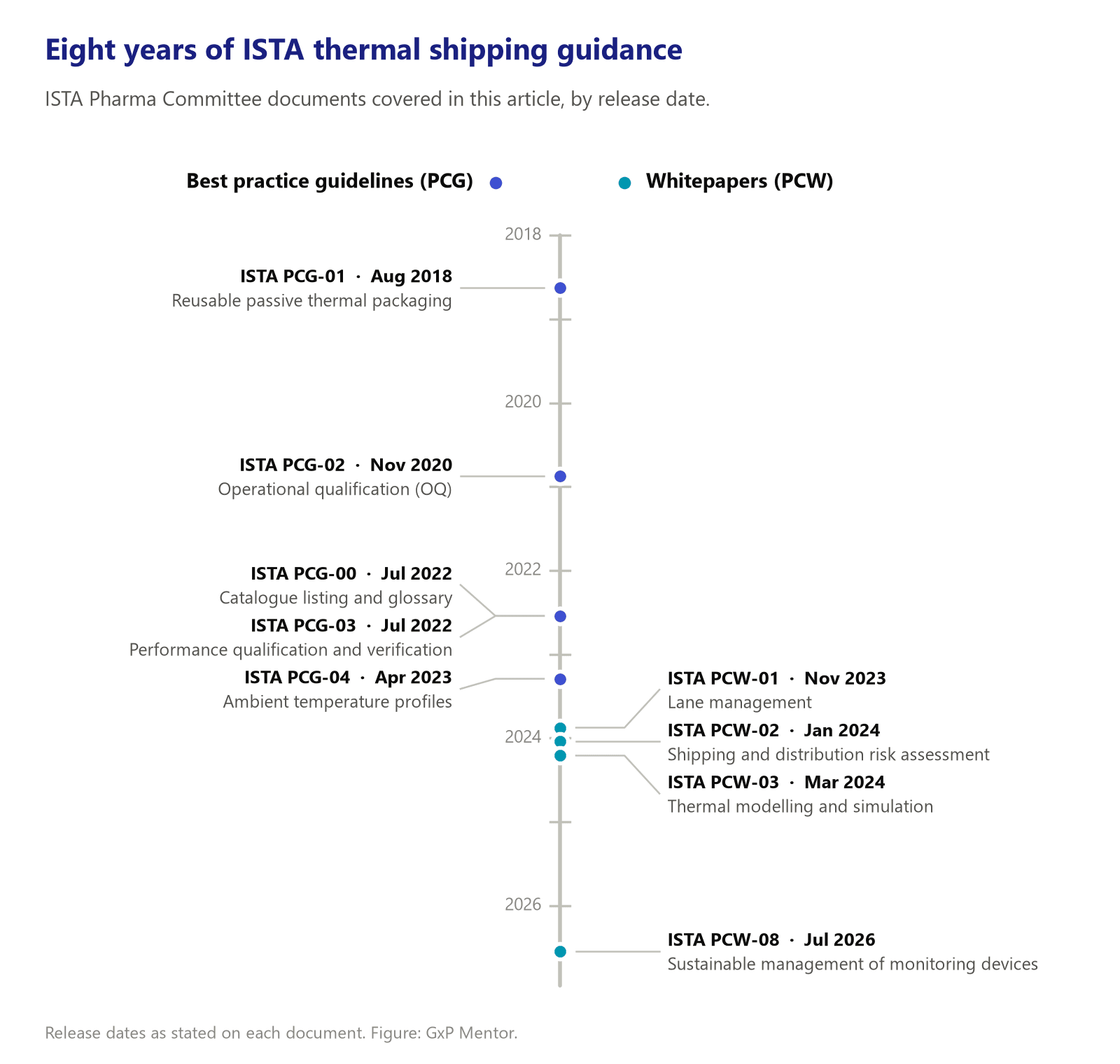
| Document | Released | Focus |
|---|---|---|
| ISTA PCG-01 | August 2018 | Reusable passive thermal packaging systems |
| ISTA PCG-02 | November 2020 | Operational qualification of passive thermal packaging systems |
| ISTA PCG-00 | July 2022 | Catalogue listing and glossary of terms |
| ISTA PCG-03 | July 2022 | Performance qualification (PQ) and performance verification (PV) |
| ISTA PCG-04 | April 2023 | Ambient temperature profiles (ATPs) |
| ISTA PCW-01 | November 2023 | Lane management |
| ISTA PCW-02 | January 2024 | Shipping and distribution risk assessment |
| ISTA PCW-03 | March 2024 | Thermal modelling and simulation |
| ISTA PCW-08 | July 2026 | Sustainable management of temperature monitoring devices |
Table 1: ISTA Pharma Committee documents referenced in this article, with release dates as stated on each document.
Operational qualification got a common playbook
PCG-02 (2020) set out an aligned approach to the operational qualification of passive systems: test equipment, temperature monitoring, profile selection, product loads, orientation, mechanical testing and documentation. Part of the motivation was practical. Pre-qualified systems reduce the need for every user to run their own OQ.
The catch, and it's an important one, is that a supplier's OQ was run against a specific payload. Before relying on an already qualified system, PCG-02 recommends a risk assessment comparing what was tested with what you actually intend to ship (PCG-02, section 4.4). It also flags orientation. Parcel shipments can end up on their side, and designs that aren't symmetrical can perform quite differently when they do (section 4.5).
A temperature profile now needs defending
For years the question was simply which published profile to use. PCG-04 (2023) reframes it. The profile should reflect what the package will realistically experience, and that goes beyond local weather to factors such as direct sunlight, radiant heat, warehouse and vehicle temperatures, and wind (PCG-04, section 3).
It also names a gap many teams quietly work around: there hasn't been much guidance on how to build a profile you can defend, or how to evaluate and compare one profile with another (section 1.1). Its answer is risk-based. Where published profiles don't adequately cover your supply chain, a risk assessment decides whether you need a custom one (section 6.1). Even in 2020, PCG-02 asked for profiles grounded in technically justifiable criteria, whether that's monitoring data from real shipments, historical environmental data or a published industry standard (PCG-02, section 4.3).
Performance verification sits alongside PQ
For me, PCG-03 (2022) is the most practically significant of the set. It covers performance qualification, the real-world test shipments that follow OQ, and it also describes performance verification.
Performance verification doesn't rely on protocol-driven test shipments. Instead, every routine shipment is monitored against the acceptance criteria, and the results are documented through periodic review. PCG-03 describes PV as something that can be used instead of PQ or alongside it, with a risk assessment to justify using it instead, and it regards PV as the more robust process because it draws on a much larger data set. Over time, further risk assessment can justify reducing how many shipments are monitored (PCG-03, section 8).
It brings more discipline to PQ as well, through bracketing: worst-case lanes, representative shipper platforms, and minimum and maximum payloads (section 7.1). And it expects a periodic review, summarised in a report, at a frequency set by your process controls, trends and risk (section 11).
Lanes are managed across a lifecycle
PCW-01 (2023) introduced lane management, noting that there had previously been no industry guidance or position documents on the subject. It describes four phases across the life of a lane: characterisation, assessment, implementation and performance review. It also treats lane management as a cross-functional process, not something packaging engineering owns alone (PCW-01, section 1.0).
PCW-02 (2024) adds a structured approach to shipping and distribution risk assessment. It's typically triggered by a change to a product configuration, a shipping system or a lane, and the stated aim is to bring risk levels and monitoring frequency down over time as controls prove themselves (PCW-02, sections 1.0 and 3.6).
Thermal modelling has joined the toolkit
This is the one I had a hand in, so take my enthusiasm with an appropriate pinch of salt. PCW-03 (2024) looks at how thermal modelling and simulation are being used across temperature-controlled distribution. It separates the two ideas: a model is a digital representation of the shipping system, and a simulation is running that model under different conditions, such as payloads, profiles and durations (PCW-03, section 1.0).
The tools range from home-built spreadsheet calculators to full finite element and computational fluid dynamics software, and the whitepaper is careful to point out that more detail doesn't automatically mean more accuracy. What matters is properly characterised materials, sensible boundary conditions and a model that's been checked against real test data (section 2.0). One of the clearest applications is design qualification, where exploring a wide design space virtually can shorten the chamber testing that follows (section 4.0). The conclusion is deliberately measured: the potential is large, but its use should be assessed against risk, current regulations and, ultimately, product and patient safety (section 5.0).
Sustainability has reached the monitoring device
Reuse isn't new. PCG-01 (2018) set out how to qualify reusable passive shippers, including tracking how many times and for how long components are used, and keeping their performance under ongoing verification (PCG-01, section 4).
The newest document in the set, PCW-08 (July 2026), turns the same thinking onto temperature monitoring devices. Many supply chains still use devices once and discard them, electronics and batteries included. The whitepaper sets out how devices can move through return, refurbishment, reuse and recycling, with reference to the EU's WEEE Directive (PCW-08, section 1.0).
It also takes a position worth watching. It argues that yearly recalibration requirements don't reflect how long many devices actually remain accurate, and calls for calibration intervals to be re-evaluated against real-world performance data (section 6.1). That's the whitepaper's argument rather than settled practice, and your own quality system still sets your intervals today. It's interesting to read alongside PI 006-4, though, which asks for loggers to be calibrated at an appropriate frequency rather than naming one.
Our view: what's actually changing
Put side by side, these documents point the same way. Qualification is moving from a one-off event to a managed lifecycle. Assumptions that used to be accepted without much question, like a standard profile or a supplier's OQ, increasingly need a documented rationale. And real shipment data is being treated as evidence in its own right, not just as a record.
None of that means existing systems are wrong. It means the questions an auditor or a customer asks are getting sharper. A few worth asking of your own shippers:
- Can you explain why your ambient temperature profile represents your actual lanes, beyond “it's the standard one”?
- Does your qualification still cover the product and payload you ship today?
- Have you decided, and documented, whether PQ, PV or both suit each lane?
- Is lane performance reviewed on a schedule, with a report at the end of it?
- Where you rely on modelling, has the model been checked against real test data?
- Do your monitoring devices have a defined calibration interval and an end-of-life plan?
If some of those don't have tidy answers yet, that's normal. The guidance itself has only recently caught up with them.
This article is written in a personal capacity. The author is a member of the ISTA Pharma Committee and a co-author of ISTA PCW-03. The views expressed are the author's own and are not an official ISTA position.
ISTA documents are copyright of the International Safe Transit Association. They are summarised and cited here, not reproduced, and current versions are available from ista.org. Section references and release dates are as stated on each document.
Other references: WHO Technical Report Series No. 992 (2015), Annex 5, Supplement 13, Qualification of shipping containers; and PIC/S PI 006-4, Recommendations on Qualification and Validation, in force from 1 October 2026 (picscheme.org).
Readers should always work from the current published text rather than a summary of it.