I always love reading a good regulatory document. Even re-reading one gives you new insights, and over the years I have re-read a lot of them.
In one of my last articles I introduced the graffiti artists of the pharma world: SAHPRA and the SAPC, the two South African regulatory bodies, where they came from, and how they sit under the Department of Health. I ended by promising we would look next at some of the guidelines themselves, the documents that decide what ends up written on the side of your medicine box. This is that article.
Here is the scenario. When I mention a clause from a SAHPRA guideline, or WHO TRS 1025, or PIC/S, I usually get one of three responses: a nod that means nothing, a blank look, or the dismissive wave. None of those are ignorance. They are what happens when somebody's bandwidth is already depleted, they have been handed forty documents from a dozen organisations, all written with equal confidence, and nobody has ever explained which ones they can actually be held to.
An important distinction to make: The Act says what. The guideline says how. Both reach you.
The cleanest way I have heard this put, and the way I have thought about it for years, is that the legal instrument tells you what to do and the guidance tells you how to do it. Act 101 requires a wholesaler to hold a licence and to work to good wholesaling practice. It does not tell you where to put a sensor, or what should be considered in an SOP.
That division explains something that confuses people the first time they read a SAHPRA guideline closely. Open the South African Good Wholesaling Practice guideline and its own cover page says1:
“This document has been prepared to serve as a recommendation to applicants wishing to conduct business as medicine wholesalers. It represents the South African Health Products Regulatory Authority's current thinking on the safety, quality, and efficacy of medicines. It is not intended as an exclusive approach.”
And its section 2:
“This guideline supports legislative requirements as outlined in the various Acts. This guideline does not replace or supersede any aspect as described in any one of the Acts or the Regulations within the Acts.”
The operative words are: recommendation, current thinking, not exclusive, does not supersede. Read quickly, that sounds like the guideline is optional. It is not, and reading it that way is how people get themselves into trouble.
What those words actually mean is narrower and far more useful. The guideline is not the legislation, so it cannot create an obligation the Act does not support, and it is not the only acceptable way of meeting the requirement. If you can demonstrate another approach that meets the same requirement, the guideline leaves you the room to use it. What it does not leave you is the option of ignoring it.
The reason you cannot ignore it is that the obligation to work to a practice code sits in the law itself. Section 22C(1)(b) of the Medicines and Related Substances Act 101 of 1965 requires manufacturers, importers, exporters, wholesalers and distributors to hold a licence2. Regulation 23 of the General Regulations then requires “the ability to comply with good manufacturing, wholesaling, or distribution practices as determined by the Authority“2. The guideline is that determination. It is the document you are audited against, and in practice a finding is written against its clauses, not against the Act.
So both reach you, in different ways. The Act and your licence create the obligation. The guideline sets the standard you are measured against and tells you how to meet it. Those five words, as determined by the Authority, are loaded with meaning, and we will come back to them.
Which raises the question the rest of this article is about. Once you accept that a document can reach you without being legislation, you need a way to judge how far any given document reaches. The answer is to stop ranking them by how authoritative they sound and start ranking them by what happens if you ignore them.
Three tiers exist and they are about enforceability, not authority
Categorised that way, the pile falls into three groups.
Primary sources are legally mandated. The Acts, their Regulations, your licence conditions, and the guidelines your own authority issues under them. In South Africa: Act 101 of 1965, the Pharmacy Act 53 of 1974, and what SAHPRA and the SAPC publish beneath them. These tell you what is required.
Secondary sources are international guidelines and bodies. WHO, PIC/S, the EU, ICH. Not law here on their own. They bind you when your authority adopts them, references them, or inspects against them, which happens more often than most people realise. These tell you how your regulator expects it done. The clearest local example is PIC/S: SAHPRA adopted its GMP guide outright, so for a South African manufacturer it has stopped being a secondary document at all, and it sits in the reference list behind the wholesaling guideline too.
Tertiary sources are global guidance organisations. PDA, ISPE, ISTA, ISO, IATA. Industry consensus written by practitioners. Nobody can cite ISPE at you as a legal requirement. These tell you how the work is done well, and they are frequently the most useful documents in the pile.
Two refinements, because the neat version is not quite true
USP does not fit in one tier. General chapters numbered above <1000>, which includes <1079> on storage and shipping and <1079.2> on mean kinetic temperature, are informational. Compendial monographs and chapters below <1000> are a different matter: they become enforceable through a product's registered specification. SAHPRA expects a Responsible Pharmacist to demonstrate “an understanding of relevant pharmacopeial requirements”2. So treat USP as two things wearing one name.
Tertiary does not mean unimportant. If you want to know how to run a mapping study, the ISPE guidance will help you more than any Act ever will. It will simply not save you when the primary source says otherwise.
How the tiers actually connect
That categorisation holds right up until you open the documents and find them quoting each other.
South Africa does not write its own GMP guide. The SA Guide to GMP, version 7, July 2019, carries a section titled “Adoption and Adaptation of the PIC/S GMP Guide”, and says3:
“As such, SAHPRA has adopted the PIC/S Guide to GMP and all prospective adaptations as prescribed by the PIC/S.”
The current guideline, SAHPGL-INSP-02 version 10 of 13 April 2026, carries the same clause at section 2.1, spelled “PICS” without the slash2.
Read the last six words of that quote again. And all prospective adaptations. On its face, South Africa did not adopt a document, it adopted a subscription.
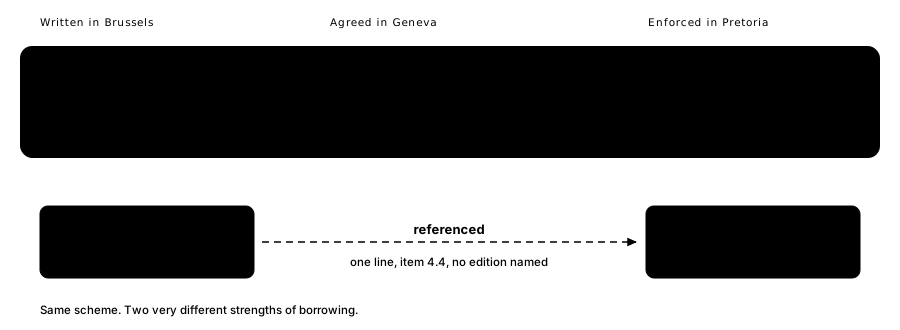
By subscription I mean this. A normal adoption names an edition: you comply with that text until your regulator publishes a new one, and you can date your obligations. A subscription names the source instead. Whatever PIC/S issues next is, on this wording, already part of what SAHPRA adopted, so your GMP obligations can change on a Geneva publication date with nothing arriving from Pretoria to tell you. Figure 1 shows the difference between that and an ordinary reference.
The document history bears that reading out. The Medicines Control Council adopted the PIC/S GMP Guide of July 2004, effective January 2006. The adoption of PE 009-13, the PIC/S edition of 1 January 2017, took effect in December 2017. And version 10 names PE 009-17 five separate times, once in each licence category, when it sets competence requirements for responsible pharmacists: Annex 1 for sterile, Annex 9 for non-sterile, Annexes 1 and 2B for biologicals and vaccines, Annex 6 for medical gases, Annex 3 for radiopharmaceuticals2.
PIC/S published PE 009-18 on 24 September 20264.
So which edition applies to a South African manufacturer this morning?
The case for the newer one
The adoption clause says prospective adaptations are included. The references section of version 10 lists simply “PICS GMP Guideline”, with no edition number at all2. South Africa is a PIC/S Participating Authority, and the point of a scheme is harmonisation.
The case against, which is stronger than I first allowed
PIC/S itself says its guides are not self-executing. The introduction to the PIC/S Guide to GDP states5: “This Guide has been adopted by PIC/S as a guidance document. It is up to each PIC/S Participating Authority to decide whether it should become a legally-binding standard.”
Regulation 23 says practices are those determined by the Authority, not by the scheme. SAHPRA's adoption is not even wholesale: the SA Guide to GMP replaces PIC/S Annex 16 with a South African Annex 163. And SAHPRA's own behaviour suggests it believes a publishing step is required, because version 9 was issued in November 2025 specifically for “Alignment with PICS Annex 16”2. If revisions moved expectations automatically, that version would have been unnecessary. The eleven-month gap between the 1 January 2017 PIC/S edition and its December 2017 South African effective date says the same thing.
My reading, and it is a reading rather than settled law: the adoption clause means you cannot treat the newer edition as somebody else's problem. The practical answer is neither to assume nor to ignore. Do a documented gap assessment between PE 009-17 and PE 009-18, put your rationale on file, and ask SAHPRA. An inspector is far more interested in whether you noticed than in which way you called it.
The chain does not start at PIC/S either. The PIC/S Guide to GDP states that it “is based on the EU Guidelines on Good Distribution Practice (GDP) of Medicinal Products for Human Use (2013/C 343/01)”56. Those EU guidelines are themselves issued under Directive 2001/83/EC. So a South African wholesaler's expectations trace back through SAHPRA to PIC/S to Brussels.
One caution on that chain. SAHPRA adopted PIC/S for GMP. For wholesaling it only references it: “PIC/S guides” appears exactly once in the 48 pages of the GWP guideline, as item 4.4 of a four-item reference list1. Adoption and reference are not the same strength, and the article's own logic requires me to point this out.
And it runs upward too. WHO TRS 961 Annex 9, the model guidance for time and temperature sensitive products, takes its definitions of qualification and validation from PDA Technical Report 39, and its definition of a service level agreement from IATA7. Its normative references include ICH Q9 and the ISO 9000 series. A secondary-tier body borrowing the two words the entire discipline runs on from a trade association.
So, the tiers are not a ladder. They are a hierarchy of enforceability laid over a web of mutual citation. Figure 2 is that web, drawn whole.
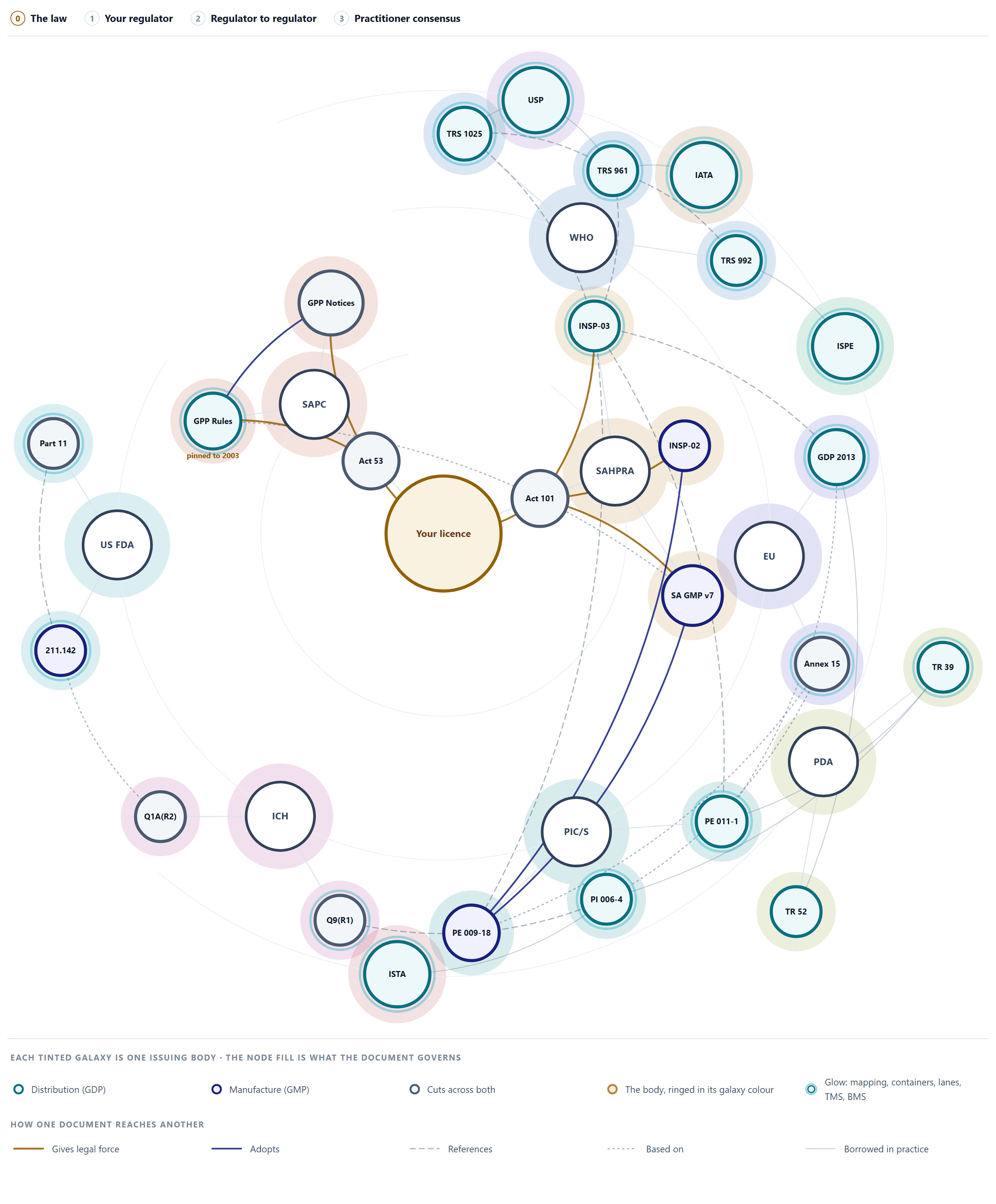
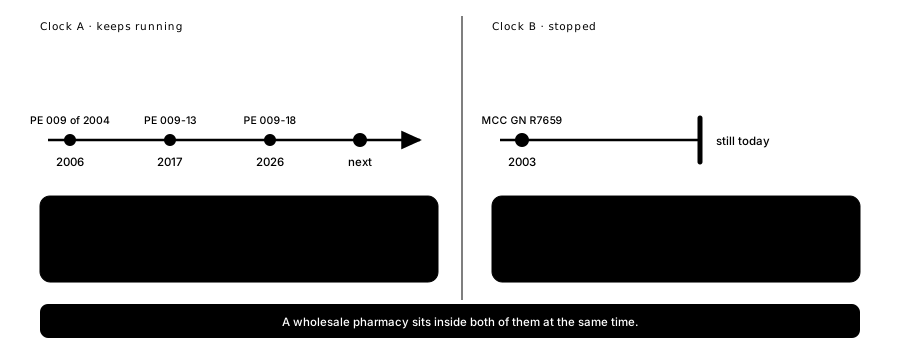
A cross-reference that carries future revisions is one way that web can surprise you: the document moves while you are not looking. The opposite failure is worse, and South Africa has a live example of it sitting in a rule that is enforced every day. Figure 3 sets the two side by side.
Rule 2.2, or the clock that stopped in 2003
The SAPC's Good Pharmacy Practice rules are enforceable against every pharmacist in the country. Rule 2.2 is live, and it reads8:
“Manufacturing pharmacies, wholesale pharmacies and distributors must comply with standards as prescribed in the Guidance Document: Good Manufacturing Practice published by the Medicines Control Council (MCC) (GN R7659 of 2 May 2003) and Good Wholesale Practice for Wholesalers, Distributors and Bonded Warehouses (MCC 6 June 2003).“
A current rule, enforced by a council that can take disciplinary steps against your Responsible Pharmacist, pointing at a 2003 guidance document published by a regulator that SAHPRA replaced in February 201824. More than eight years, and the rule still points there.
Hold that against the GMP position. In one place, a South African instrument adopted a scheme including all its future revisions. In another, a South African instrument pinned a dated 2003 edition and never moved it. Both are current. Both bind somebody. If you run a wholesale pharmacy you are inside both at once.
This is also why “just read the latest version” is not advice. There are two different failure modes here, and they pull in opposite directions.
The SAPC's moving target
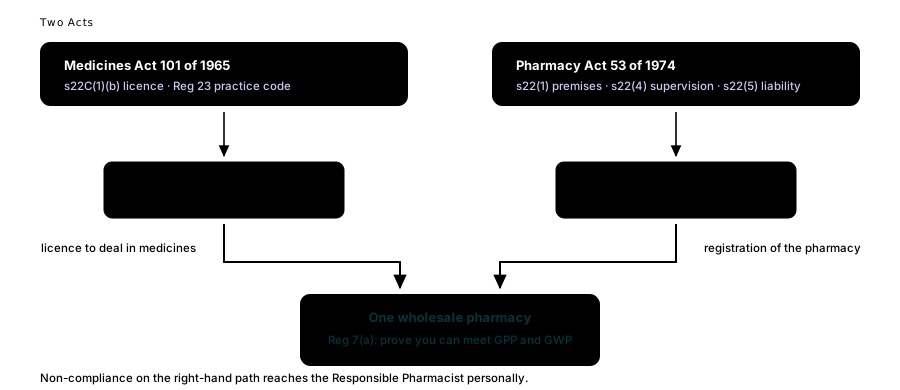
The obvious response to Rule 2.2 is to go and check what the rest of the GPP rules say. That is where the next problem starts, because there is no dated consolidated edition of them. What is in force is the Good Pharmacy Practice manual plus a stream of individual Board Notices, listed by the SAPC without dates, gazette numbers or any indication of status9. Figure 4 shows why this reaches further than it looks: a wholesale pharmacy answers to two regulators under two Acts.
Finalised since 2015: BN 84 of 2018 on premises, facilities and equipment; BN 172 and BN 205 of 2019; BN 81 of 2020; BN 70 of 2021; BN 479 of 2023 on sexual and reproductive health; BN 674 of 2024 on oncology services10; BN 751 of 2025; BN 794 of 2025 on reference sources11; BN 976 of 2026 on the authority and duties of a Responsible Pharmacist.
Out for comment and not yet final: BN 879 of 2026, BN 952 of 2026 on the prevention of fronting12, and BN 982 of 2026, “GPP - Various Amendments”. One is still open at the time of writing: GNR 7845 of 2026 on the ownership and licensing of pharmacies, with comments due 29 November 202613.
The cold chain rules are untouched by all of it. Rule 2.3.5 stands as replaced by Board Notice 50 of 2015, and it is sharper than most people expect. Rule 2.3.5.3(c) requires internal air temperature distribution to be mapped on installation while empty and then fully stocked, and thereafter annually under conditions of normal use. Rule 2.3.5.3(l) requires recording instruments to be calibrated annually against a certificated standard. Rule 2.3.5.4 requires a distribution system to have a comprehensive quality system, a process for continual quality improvement, an ambient and cold chain distribution strategy, and a risk assessment programme, and requires that packaging systems for thermolabile products be “thermally designed and validated”8. Figure 5 shows the whole stack, drafts included, and where those cold chain clauses sit in it.
If you run a community pharmacy and believed annual mapping under normal use was a manufacturer's problem, that is the clause to re-read tonight, and it is yours.
Complementary medicines: fully bound for storage, unregistered for sale
Everything so far has described registered medicines, where at least the documents exist and the argument is about which edition applies. There is a whole category on your racking or shelves where the storage rules bind completely and the registration rules have not arrived at all.
Writing in August 2026, Dr Andy Gray of UKZN set out the position14. The initial call-up notices have been repealed. The risk-based call-up has still not commenced. The Supreme Court of Appeal decided the Alliance of Natural Health Products challenge in 2022, confirming that SAHPRA should have no regulatory power over substances that do not meet the definition of a medicine. Draft amendments to the 2017 General Regulations were published for comment in March 2023 and have yet to be issued in final form. No complementary medicine has yet been registered.
SAHPRA's own guidance reflects the stall. The complementary medicines guideline set has not moved since January 2022: the roadmap is 7.02 version 2 of 8 December 2021, the health supplements safety and efficacy guideline is 7.04 version 4 of 9 March 2022, and specified substances is 7.06 version 3 of 12 January 202215. The most recent complementary-medicines-specific communication to industry is dated 2 June 202316.
Meanwhile the products are on the shelf. Category D products appear in no Schedule, so they are treated as Schedule 0 and can be sold in any retail outlet, with injectables the exception at Schedule 3. Unregistered products must carry the line “This unregistered medicine has not been evaluated by the SAHPRA for its quality, safety or intended use.”
And here is the part that belongs in a GDP and GWP article. Manufacturers, wholesalers and distributors of complementary medicines must be licensed by SAHPRA, but that licensing rests on an attestation of compliance at the time of application rather than the GMP inspection applied to other medicines, with SAHPRA reserving the right to inspect where warranted14.
So: the storage obligations bind fully. A complementary medicine in your cold room sits under the same GWP expectations and the same GPP Rule 2.3.5 as a registered medicine. The registration framework behind it has not moved in four years, and the licence of the company storing it may rest on a declaration rather than an inspection. If you are a Responsible Pharmacist signing for that stock, the gap is yours to manage, not the regulator's.
Where this is going: reliance
Well done for reading this far. Let's now talk about reliance pathways. Every example so far has shown standards arriving in South Africa from somewhere else, and arriving unevenly. The traffic is now starting to run in the other direction, and that changes what your evidence has to survive. In August 2025 SAHPRA published its renewal implementation framework, and the reasoning in it is worth reading twice17:
“it will also enable the Regulator to comply with the requirements as set out by the World Health Organization (WHO) in the Global Benchmarking Tool... as it may allow for regulators from other regions to rely on SAHPRA's regulatory decision for products registered, to facilitate shorter timelines for registrations in other markets.”
That is reliance, stated by SAHPRA in its own words. It is also what the literature has been arguing for years. Ndomondo-Sigonda and colleagues put the structural problem bluntly in their key points: “No national medicine regulatory authority in Africa can undertake the full range of regulatory functions”18. Keyter and colleagues, writing on the South African system in 2018, argued SAHPRA should adopt the risk-based review typology used elsewhere: full review, abridged review where one recognised authority has approved, verification review where at least two have, and separate evaluation of generic dossiers19.
Reliance is not a future thing. SAHPRA's current GMP guideline already lists its recognised regulators in Appendix 1: PIC/S members, WHO, and ZaZiBoNa2.
The consequence for you is simple. If your regulator leans on another regulator's assessment, the standard your evidence was built against stops being a local matter.
What this means on a Tuesday
None of this changes what is sitting on your desk this week. So here is the same argument reduced to the obligations it actually produces, depending on which side of the chain you are on.
If you are a wholesaler, SA GWP section 3.7.4.2 says the following should be validated as a minimum: warehouse premises, ambient and cold chain, including temperature mapping; lagged containers; cold chain processes; computerised systems; and transportation systems1. Note the verb. The document uses “must” freely elsewhere, so “should” is a choice, and reading it as “must” is the same tier error this article is about. Transportation is the one most often missing, and it is exactly what PI 006-4 section 6.1, Verification of Transportation, in force since 1 October 2026, asks manufacturers to document and verify by test protocol20. Which means your customer will be asking you about it.
If you run a pharmacy, Rule 1.2.8 requires thermolabile medicines to be stored per the manufacturer's instructions and refrigerators used for them to be calibrated regularly8. Calibrated. Not “checked”, not “has a thermometer in it”. And Rule 2.3.5.3(c) sets the mapping expectation above.
If you manufacture, your GMP guide is the PIC/S guide, your qualification and validation expectations moved on 1 October 2026, and your reference and retention sample rules moved on 24 September 2026.
And for everybody, the acceptance criteria you map against do not come from any of the practice guidelines. They come from the product label, which comes from the stability data, which comes from ICH Q1A(R2)21. The guideline tells you to prove the condition is held. The label tells you what the condition is.
If you are early in a QA career, read these in this order
All of that assumes you already know which documents are yours. If you are new to this, the instinct is to start with the biggest guideline on the shelf, and it is the wrong one. Work outwards from the thing that licenses you.
- Find the clause that makes your activity a licensed one, and find out how many regulators you have. For a medicines wholesaler that is section 22C(1)(b) of Act 101, plus Regulation 23 for the practice code. But if you are a wholesale pharmacy, you answer to two authorities under two Acts: the licence from SAHPRA, and under the Pharmacy Act, premises licensing via the Director-General, continuous personal supervision by a pharmacist in accordance with the SAPC's rules, and a pharmacist personally responsible for acts performed on the wholesaler's behalf, with non-compliance exposing them to Pharmacy Council disciplinary action1. Regulation 7(a) of the Pharmacy Act Regulations requires proof of ability to comply with GPP as determined by the Council and, where applicable, GWP as determined by SAHPRA. Most people discover the second regulator late and badly.
- Read your own regulator's guideline cover to cover, once. Not searched. Read. SAHPGL-INSP-03 is 48 pages. You will finish it in an afternoon and know more about your obligations than most people in your building.
- Follow its references outward, but know what you are getting. SA GWP item 4.4 says only “PIC/S guides”, with no document code or edition, and the GMP guideline's reference list says only “PICS GMP Guideline”12. That is a direction, not a map. The documents you actually want for storage and distribution are PE 011 for GDP5, PI 006-4 for qualification and validation20, and the PIC/S GDP aide-memoire and Q&A that inspectors work from.
- Only then reach for the tertiary sources, and reach for them to answer “how”, never “whether”. ISPE and PDA will tell you how to design a mapping study properly2223. They will not tell you whether you need one. Your regulator already did.
- Check the version and the date before you cite anything. SA GWP version 5 is valid for five years from its effective date. The GMP guideline is on version 10. PIC/S has issued eighteen editions of its GMP Guide. A clause reference without a version is a citation you cannot defend, and I have watched people lose arguments they were factually winning because they quoted an edition that had been superseded.
- The Medicines Control Council was replaced by SAHPRA on the establishment of the SAHPRA Board in February 2018, under the Medicines and Related Substances Amendment Act 14 of 2015. See the US FDA notice recording that the MCC ceased to exist, and contemporaneous reporting of the Board's inaugural meeting on 1 February 2018. The statutory transitional wording is summarised from secondary sources rather than quoted from the Act.
The short version
If you take one thing from all of this, take the sorting method, because it survives every change of edition. The tiers tell you what binds you. The citations tell you how they connect. The dates tell you whether you are current.
Primary tells you what is required, secondary how your regulator expects it done, tertiary how it is done well. South Africa's GMP guide is the PIC/S guide, arguably including revisions it has not yet named. PIC/S GDP is the EU's. WHO borrows its definitions of qualification and validation from a trade association. One SAPC rule still points at a 2003 document from a dissolved regulator. And the acceptance criterion at the bottom of your mapping protocol came from a stability study governed by ICH.
None of this is a reason to read less. It is a reason to read in the right order.